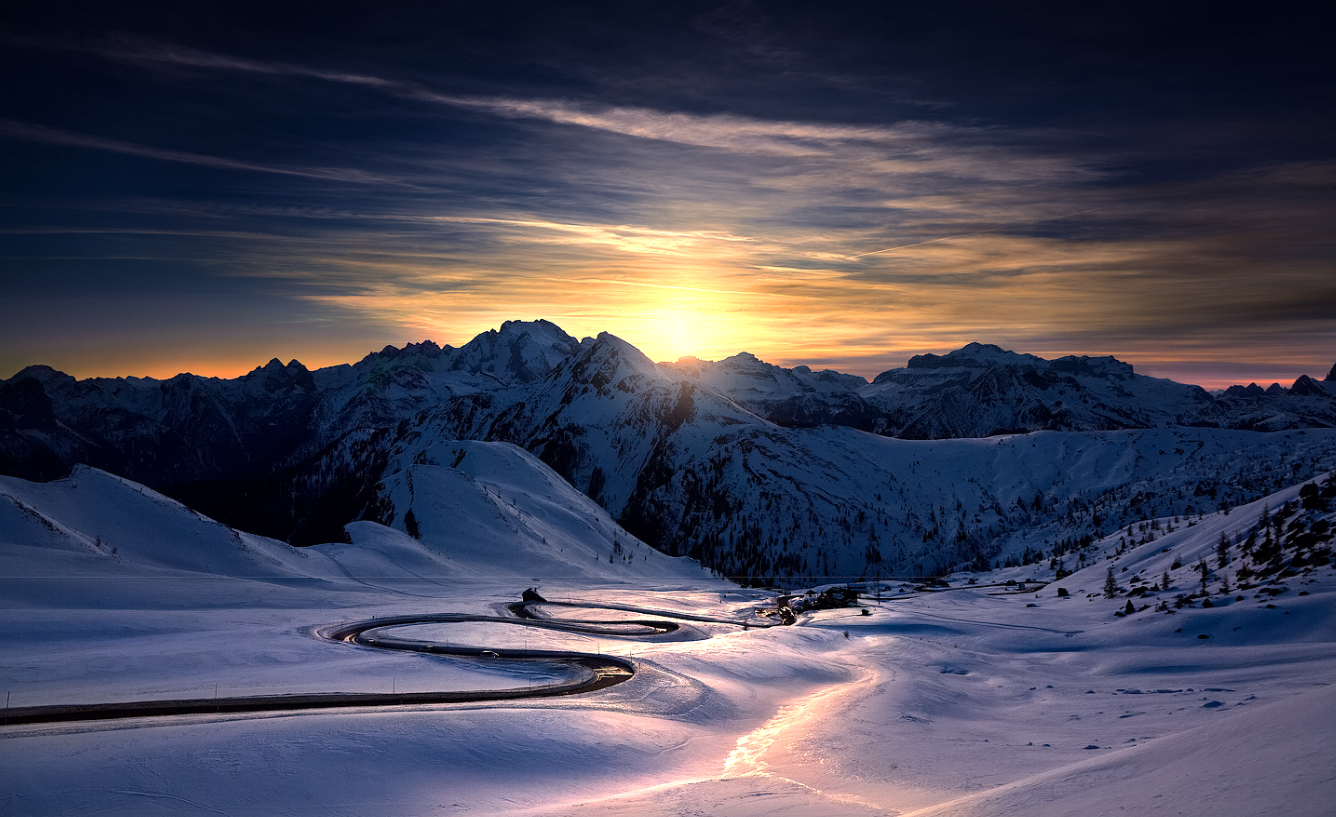
The Italian Alps and Dolomites represent the ultimate automotive filming playground, where legendary passes like Stelvio's 48 hairpins and Passo Giau's serpentine curves have become pilgrimage sites for car enthusiasts worldwide. Our specialized location scouting service goes beyond these famous routes to uncover hidden military roads, private estate drives, and forgotten mountain passages that deliver spectacular visuals without tourist complications. Understanding that each automotive production demands unique characteristics—whether showcasing electric vehicle silence on pristine tarmac or capturing rally-inspired dynamics on gravel switchbacks—we match precise location attributes to creative vision, ensuring every frame captures the perfect dialogue between machine and mountain.
Stelvio Pass: The world's most photographed driving road
The Stelvio Pass stands as automotive cinematography's most iconic canvas, its 48 consecutive hairpin turns ascending 1,871 vertical meters creating instantly recognizable sequences that define mountain driving imagery. At 2,757 meters elevation, making it the second-highest paved pass in the Alps, productions work literally above the cloud line during morning shoots, capturing vehicles emerging from mist into crystal Alpine clarity. The eastern approach from Prato offers the famous stacked hairpin view, where all 48 corners create a geometric pattern visible from multiple vantage points, while the Bormio side provides faster, more flowing sections ideal for dynamic driving sequences.
The pass's construction between 1820-1825 by engineer Carlo Donegani created remarkably consistent corner radii that generate visual rhythm in tracking shots. Each hairpin maintains approximately 180-degree turns with 14% maximum gradients , demanding precise vehicle control that naturally showcases handling capabilities. The road surface, meticulously maintained for the Giro d'Italia cycling race, provides predictable grip levels essential for performance driving, though the narrow 5-6 meter width on hairpin sections requires careful choreography for passing sequences or multiple vehicle shoots.
Top Gear's 2007 declaration of Stelvio as "the greatest driving road in the world" transformed it into mandatory viewing for automotive enthusiasts, creating both opportunities and challenges for productions. While the recognition delivers instant audience connection, summer tourist traffic can exceed 500,000 visitors between June and September. Our scouting identifies optimal shooting windows—typically pre-7 AM starts or late September weekdays—when the road returns to its essential character: a magnificent mountain challenge without witnesses.
Passo Giau: Cinematic perfection at 2,236 meters
Passo Giau delivers what many cinematographers consider superior filming conditions, its serpentine layout and varied corner sequences providing dynamic visual opportunities beyond Stelvio's repetitive hairpins. The 10-kilometer ascent from Selva di Cadore features 29 corners with progressively tightening radii, creating natural story arcs as vehicles climb toward the 2,236-meter summit. The famous "snake road" section, photographed from hillside vantage points, has become social media gold, its perfect S-curves through Alpine meadows defining automotive beauty shots.
The surrounding amphitheater of peaks—Nuvolau, Averau, Ra Gusela, and the distant Marmolada—provides 360-degree backdrop options unmatched elsewhere in the Dolomites. Morning light illuminates the eastern faces while afternoon sun backlights dramatic cloud formations, offering completely different moods from identical positions. The pass's wider road surface, reaching 7-8 meters on key sections, accommodates tracking vehicles alongside subject cars, enabling parallel running shots impossible on narrower passes.
Location advantages extend beyond pure visuals to practical production benefits. The Rifugio Giau at the summit provides essential facilities including parking, refreshments, and weather shelter for crew. Adjacent meadows offer multiple drone launch sites with clear sight lines across the entire route, while natural pull-offs every 300-400 meters allow equipment staging without blocking traffic. The proximity to Cortina d'Ampezzo—just 20 minutes—ensures rapid access to accommodation and support services while maintaining authentic mountain isolation during filming.
Hidden gems: Exclusive roads beyond tourist routes
Our location expertise reveals the Dolomites' secret automotive treasures: military roads, forestry tracks, and private access routes that deliver spectacular settings without public traffic complications. The Kaiserjägerstraße near the Austrian border features 111 corners over 24 kilometers, originally carved for WWI military transport, now providing rally-style sequences through dense forest. Former NATO installation roads around Monte Pasubio offer concrete surfaces and dramatic elevation changes perfect for performance testing narratives.
Private estate roads through South Tyrolean vineyards provide controlled environments with aesthetic appeal. These locations, accessible through our established relationships with landowners, feature manicured landscapes, architectural elements, and seasonal variations from spring blossoms to autumn harvest colors. Estate roads often include villa driveways, agricultural tracks, and service paths that together create diverse shooting options within single properties, eliminating location moves and maintaining production momentum.
Industrial access roads to ski resorts and hydroelectric facilities offer another category of controlled locations. The service road to Seceda presents 1,000 meters of elevation gain through 18 hairpins, completely closable outside ski season. Mining roads near Predazzo feature unique geological backdrops with colored rock strata creating natural production design. These alternatives often provide superior filming conditions to famous passes: wider lanes, better sightlines, controllable access, and zero tourist infrastructure to remove from frame.
Seasonal dynamics shape location character
Alpine locations transform dramatically across seasons, each offering distinct production opportunities. Spring arrives progressively up the mountains, with valley roads clear by March while high passes remain snow-bounded until May, creating opportunities to film seasonal transitions within single shooting days . Fresh tarmac emerges from winter revealing perfect surfaces unmarked by summer traffic, while snowmelt waterfalls provide dynamic natural elements and authentic mountain atmosphere.
Summer's extended daylight—sunrise at 5:30 AM, sunset past 9 PM—maximizes shooting hours, though afternoon thunderstorms require morning-focused schedules. The famous Alpine "golden hour" extends remarkably at elevation, with side-lighting persisting across morning shoots from 6-10 AM. Autumn delivers peak visual drama as larch forests turn gold against evergreen backgrounds, while morning mists pool in valleys creating layers of depth. The September-October window combines stable weather, minimal traffic, and spectacular colors.
Winter transforms familiar routes into entirely different locations. Snow walls reaching 3-4 meters frame cleared passes, creating dramatic corridors that emphasize vehicle isolation against hostile environments. Limited winter access to certain passes ensures exclusive filming conditions, though requires specialized vehicle preparation and safety protocols. The low winter sun maintains favorable angles throughout shortened days, with blue-hour conditions extending shooting possibilities despite 4 PM sunsets.
Technical road characteristics define shooting potential
Understanding road engineering determines location suitability for specific automotive narratives. Corner radius directly impacts achievable speeds and visual dynamics—tight 15-meter hairpins suit technical precision while sweeping 100-meter curves enable high-speed sequences . Gradient percentages affect vehicle behavior: 8-10% grades showcase climbing power, while 14% maximums challenge traction limits. Road width varies from 4-meter single lanes requiring careful timing to 10-meter sections allowing side-by-side racing formations.
Surface quality ranges from pristine smooth tarmac on maintained passes to deliberately rough sections adding authentic challenge. Elevation changes affect both vehicle performance and visual atmosphere—thin air above 2,000 meters reduces engine output by 20%, naturally demonstrating forced induction advantages. Camber angles on corners vary from positive (helping vehicles turn) to adverse (adding difficulty), each creating different visual dynamics as vehicles lean into or fight against turns.
Natural features enhance or complicate filming: rock faces provide acoustic amplification for engine sounds, while open meadows allow long-lens compression shots. Tree coverage affects lighting consistency—dappled forest light creates mood but complicates exposure. Wind exposure on high passes impacts both vehicle stability and drone operations, with certain locations experiencing predictable daily patterns our scouting documents. These technical details, catalogued across our location database, ensure perfect matching between creative requirements and location capabilities.
Logistical intelligence enables smooth productions
Mountain filming demands precise logistical understanding that our location scouting provides comprehensively. Mobile network coverage maps show exactly where communication drops, requiring satellite backup or radio relay positions . Our scouts document equipment transport times between setups, accounting for altitude effects on vehicle performance and narrow road delays. Fuel availability becomes critical during long mountain days—we identify every station, their operating hours, and fuel types available.
Weather escape routes prove essential when conditions deteriorate rapidly at altitude. Our location packages include detailed contingency plans : which valleys to descend toward improving weather, alternative passes when primary routes cloud over, and covered locations for weather holds. Emergency protocols specify nearest medical facilities, helicopter landing zones, and evacuation procedures specific to each location's unique challenges and access limitations.
Accommodation logistics significantly impact mountain productions. We identify hotels understanding production schedules—early departures, late returns, equipment storage needs. Restaurant availability for crew catering varies dramatically by season and location. Our scouting notes which establishments remain open during shoulder seasons, who provides takeaway services for location catering, and where to source specialty dietary requirements in remote mountain areas.
Permit navigation requires local expertise
The complexity of Alpine filming permits demands deep understanding of overlapping jurisdictions. Mountain passes frequently cross provincial boundaries—Stelvio traverses both Bolzano and Sondrio provinces—requiring separate applications with different requirements . Some roads fall under national jurisdiction, others provincial, still others municipal, each with distinct processes and timelines. Military roads require defense ministry clearance, while UNESCO World Heritage areas need environmental assessments.
Our location services include comprehensive permit guidance: which authorities control specific sections, their individual requirements, and critically, which officials make decisions. We've mapped the permit landscape across the entire Alpine region , understanding that what's possible in South Tyrol differs from Lombardy or Veneto regulations. This knowledge prevents productions discovering permit impossibilities after creative commitment to specific locations.
Timing varies dramatically between authorities—some process applications within days, others require months. Special events like the Giro d'Italia or Mille Miglia create automatic blackout periods when permits become impossible. Local festivals, religious processions, and agricultural seasons affect availability. Our scouting reports include detailed permit timelines, helping productions plan realistic schedules that account for bureaucratic realities alongside creative ambitions.
Location matching: From concept to perfect road
Our location matching process begins with understanding the production's core narrative. Performance showcases require different characteristics than lifestyle pieces—technical courses with measurable challenges versus scenic routes emphasizing journey over capability. Brand positioning influences location selection : established luxury brands suit manicured estate roads, while challenger brands benefit from raw, undiscovered routes. Electric vehicles need different storytelling environments than combustion engines—silent running through nature versus mechanical symphony against mountain acoustics.
Vehicle type determines location feasibility. Supercars with minimal ground clearance require smooth surfaces and gentle approach angles, while SUVs can tackle rougher terrain expanding location options. Motorcycle productions need specific lean angles and run-off areas for safety. Commercial vehicles require gradient considerations and turning radius accommodations. Our database tags each location with vehicle suitability ratings based on actual testing.
Creative vision guides final selection from technically suitable options. Morning mist opportunities, sunset alignments with specific corners, seasonal color possibilities—we document when each location delivers specific atmospheric conditions. Our scouting captures locations across multiple visits, showing how weather, time, and season affect visual potential. This comprehensive documentation ensures productions arrive at perfect moments when locations reveal their full cinematic potential.
Evolution of automotive filming locations
The Dolomites' role in automotive filming evolves continuously as production needs change. Early automotive filming focused on proving mechanical capability—steep grades, tight corners, challenging conditions. Modern productions increasingly seek emotional resonance over technical demonstration , using mountain roads as metaphors for personal journey or brand evolution. This shift opens previously overlooked locations: contemplative routes through ancient forests, meditative passages along mountain streams, spiritual ascents toward summit revelations.
Electric vehicle proliferation creates new location requirements. Productions seek routes where silence becomes a character —away from traffic noise, through spaces where tire whisper and wind rush dominate soundscapes. Charging infrastructure influences location selection, though portable generators enable remote shooting. The contrast between futuristic vehicles and timeless landscapes creates compelling visual narratives our scouting specifically addresses.
Drone cinematography revolutionizes location potential, revealing perspectives impossible with traditional ground-based cameras. Routes previously dismissed for lacking roadside viewpoints become spectacular when filmed from above. Our aerial scouting identifies drone-specific opportunities : valleys creating natural amphitheaters, ridgelines enabling parallel tracking shots, weather patterns producing dramatic cloud interactions. This aerial intelligence expands the Dolomites' automotive filming vocabulary beyond traditional road-level perspectives.
Sustainability shapes future location selection
Environmental consciousness increasingly influences automotive filming in protected Alpine regions. Productions seek to demonstrate responsibility while capturing natural beauty, requiring locations balancing accessibility with conservation. Our scouting identifies low-impact alternatives to sensitive areas: roads with existing infrastructure avoiding new environmental pressure, locations where filming activity benefits local communities through economic support, routes where production presence helps maintain road quality benefiting all users.
The UNESCO World Heritage designation of the Dolomites creates both restrictions and opportunities. Productions gain prestige associating with protected landscapes while accepting environmental responsibilities. Our location expertise includes understanding conservation zones, seasonal restrictions, and species protection areas affecting filming permissions. We identify buffer zones offering similar aesthetics without conservation complications, ensuring productions meet environmental obligations while achieving creative goals.
Future location development focuses on sustainable access rather than new construction. Existing roads receive selective improvements—passing places, viewing areas, safety barriers—without altering essential character. Our ongoing location research documents these changes, ensuring productions understand how infrastructure evolution affects filming potential. This forward-looking approach helps productions plan long-term campaigns knowing locations will remain accessible and authentic.
download full scouting pdf
Download our comprehensive scouting guide in PDF format, featuring a curated selection of top photo and video locations in Torino, Piemonte. Explore charming streets, iconic landmarks, and picturesque public spaces ideal for street, editorial, and automotive shoots. With detailed insights and recommendations, our scouting guide ensures a seamless experience for photographers and videographers seeking the perfect backdrop for their projects.